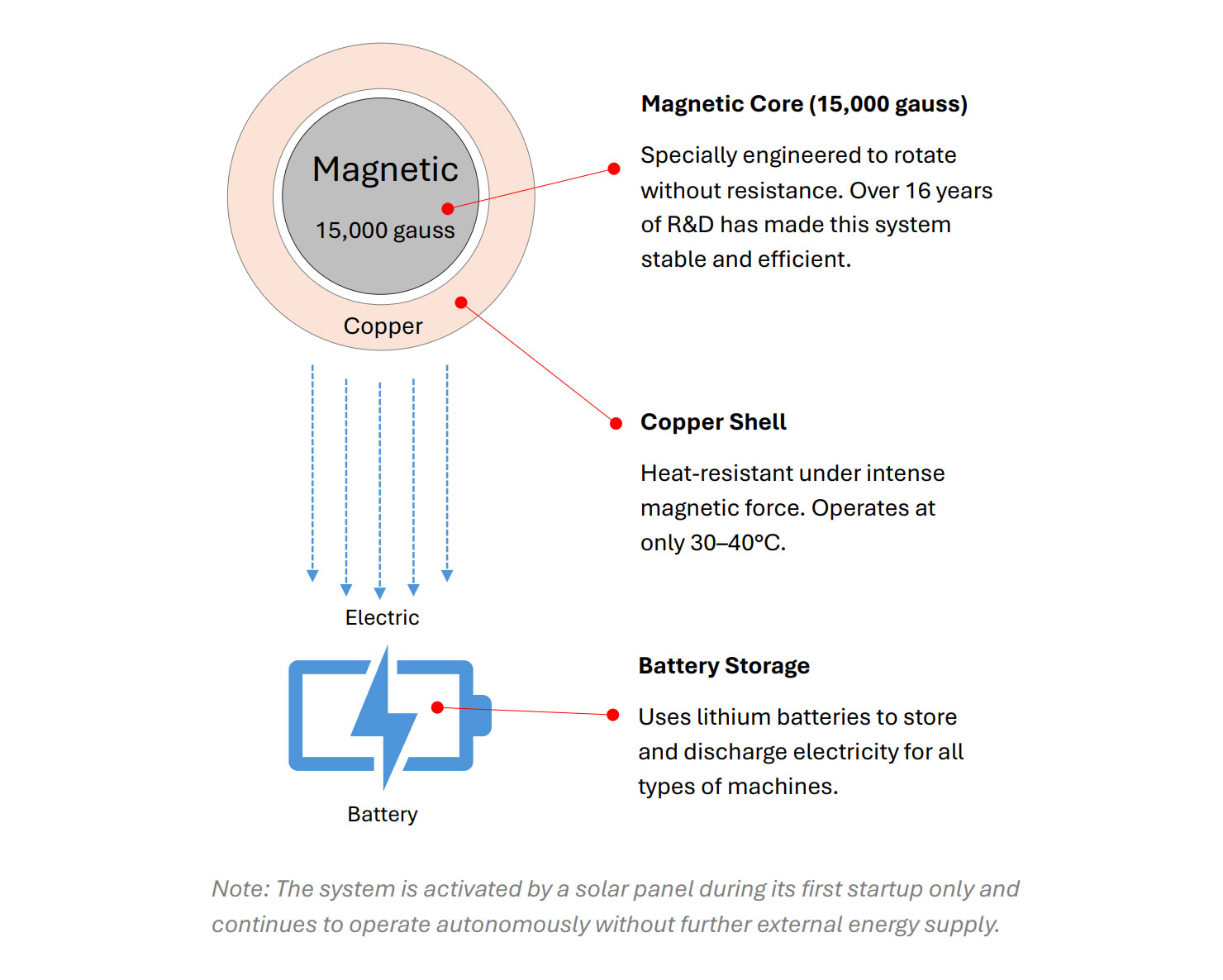
AEC is in the process of registering this innovative form of energy. The magnetic-based system has been developed and refined over more than 16 years and has been demonstrated and verified by both public and private sector entities in countries such as the Netherlands, Malaysia, China, Uganda, Myanmar, Laos, Japan and others.
This breakthrough technology is expected to play a transformative role in the global energy sector. At present, AEC will fully deploy magnetic energy in its rice cultivation project to support complete carbon reduction.
AEC Magnetic electric generator
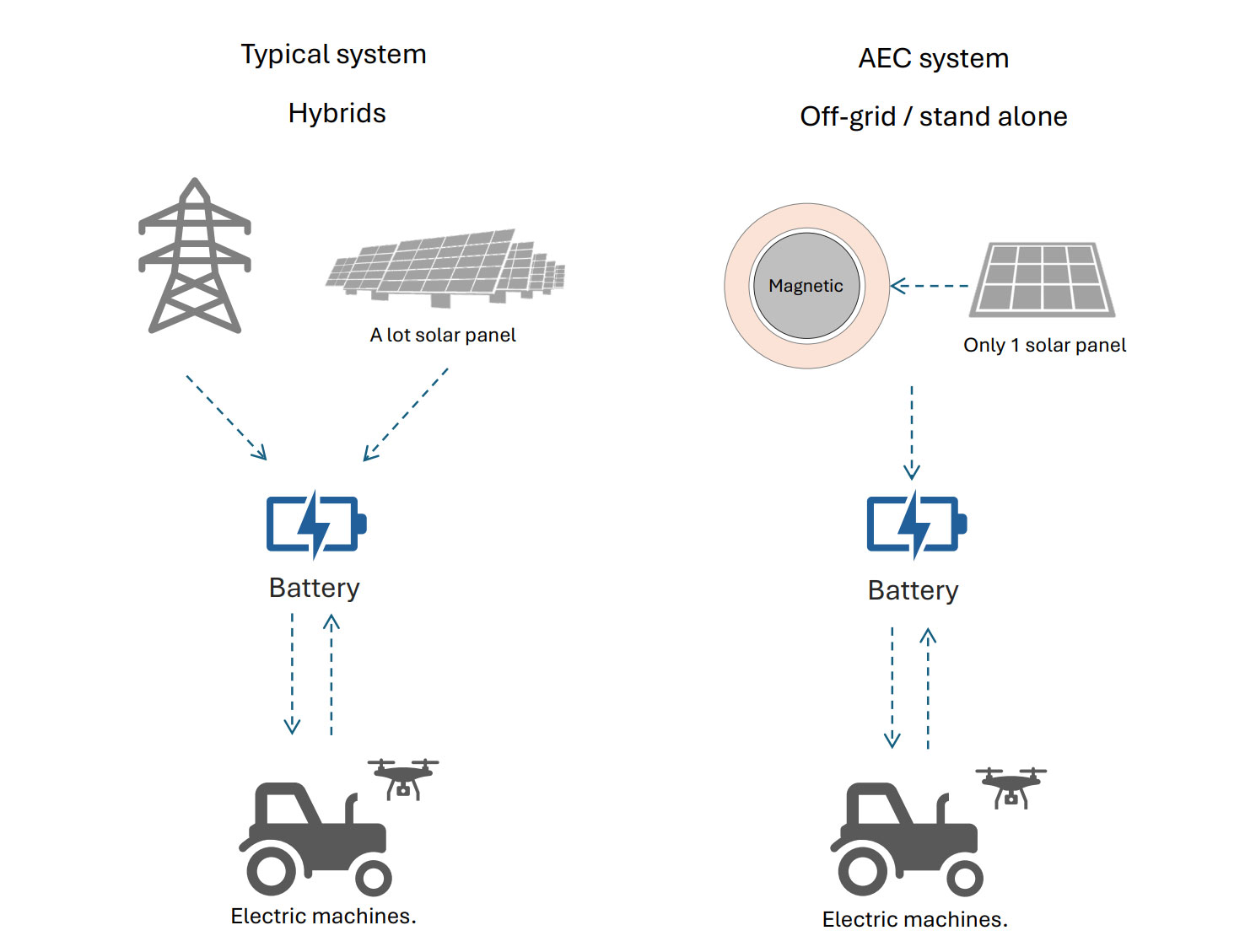
Relies on the main power grid (not suitable for remote areas)
Fully independent from the power grid, requiring only minimal solar input for startup
Battery degrades faster when electricity supply is unstable
Operates reliably in remote or off-grid areas
Requires complex control systems (inverters, controllers)
Provides a stable and continuous energy supply Compatible with all types of electric appliances and machinery
Generates electricity only when sunlight is available (unless grid backup is present)
Scalable for various applications from small farms to industrial use Supports both stable AC and DC outputs
Exclusive Summary
Why did AEC choose Low Carbon Rice over more prominent energy solutions like electricity?
While global efforts to fight climate change often focus on energy, AEC believes the root cause lies in poverty, impacting food, energy, equality, health, and the environment. Among these, food is the foundation. Without food, nothing else
functions. AEC chose to start with rice because it connects directly to climate issues
like methane emissions, fertilizer use, water overuse, and burning. Rice is where the
problem meets the people.
By transforming rice into a truly low carbon crop, AEC creates a model that can scale across all agriculture strengthening food systems, reducing emissions, and building resilience from the ground up. Sustainability doesn't start from the top it starts with rice.
Why AEC Stands Apart in the Low Carbon Rice Market
While many rice producers are beginning to explore low-carbon farming, AEC has
already engineered a fully integrated, scalable, and high-margin model that outpaces the
competition in every critical dimension: yield, carbon credit volume, cost efficiency, and
market access.
AEC’s proprietary AWD+ system is combined with magnetic-powered machinery to
significantly lower emissions across the entire supply chain. This leads to carbon credit
generation up to 10 times higher than the industry average as high as 60 tons of CO₂e per hectare.
AEC’s Low Carbon Rice solution is specifically designed to reduce emissions from all
three major greenhouse gases in rice farming:
1. Methane (CH₄)
A major greenhouse gas from flooded rice fields. AEC uses AWD+ to reduce soil
saturation, cutting off anaerobic conditions that cause methane. Verified via
transparent MRV systems.
2. Carbon Dioxide (CO₂)
Most farms rely on fossil-fueled machinery. AEC replaces all with magneticpowered machines, eliminating CO₂ emissions from operations entirely.
3. Nitrous Oxide (N₂O)
Though less discussed, N₂O is 270x more potent than CO₂ and comes from
synthetic fertilizers. AEC uses 100% organic fertilizer and optimized nutrient
management to effectively reduce N₂O, even without formal MRV in place.
AEC’s Low Carbon Rice system produces three distinct value-generating assets.
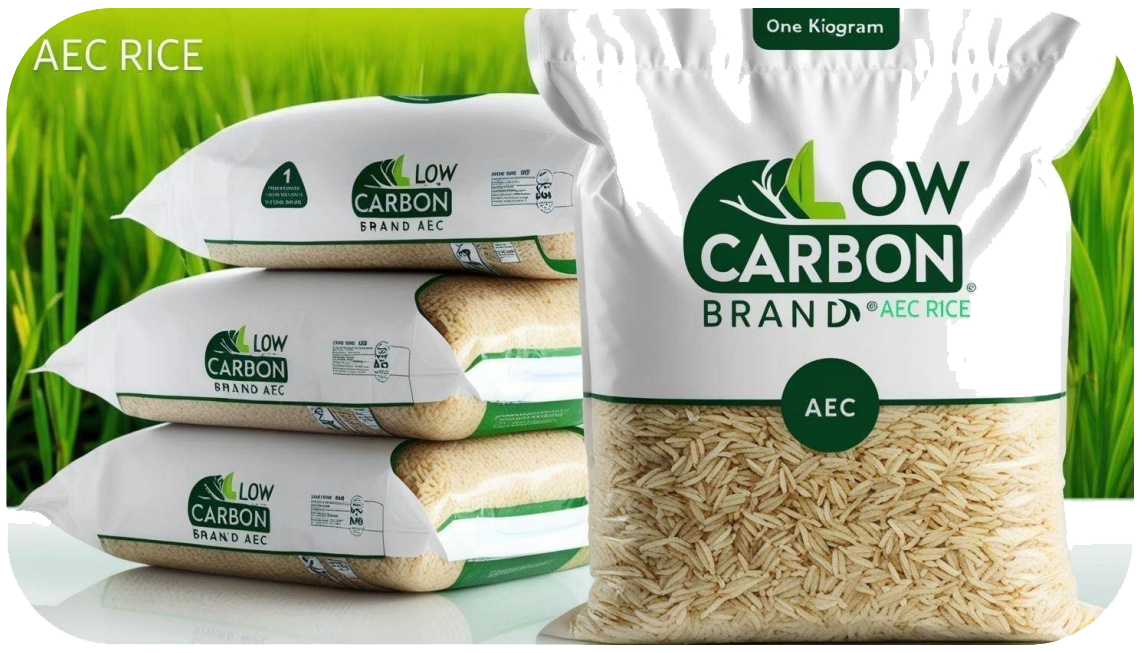
1.Rice Low Carbon
High-yield rice cultivated using AWD+ irrigation and
magnetic energy technology.
This method significantly
reduces both methane and
CO₂ emissions from the
source. Premium-quality
low carbon rice sold at up to
150–200 THB/kg in
international markets (e.g.,
EU), with a production cost
under 30 THB/kg.
2.Carbon Credit CO2e
Certified carbon credits
generated through the
farming process. These
credits can be sold in global
markets (e.g., VCM, CBAM,
CRCF), or partially allocated
into the AEC1 ecosystem to
enable digital ESG rewards
and traceability. Each
hectare generates 42–60
tons of CO₂e, sold at $20–60
per ton, depending on
market (VCM, CBAM, CRCF).
Partial credits can also be
tokenized.
3.AEC token (Cryptocurrency)
A blockchain-based token that
digitizes the environmental
value of real-world carbon
reductions. Used for staking,
rewards, governance, and
exclusive access within AEC’s
ESG-integrated marketplace.
Used for staking, rewards, and
exclusive access. As ecosystem
usage grows, so does demand
for AEC1 indirectly tied to both rice and credit sales.
AEC’s Low Carbon Rice system turns rice, carbon credits, and tokens into real income
and practical benefits for everyone involved. Farmers earn more by selling rice at
premium prices, while lowering their costs through clean energy and organic fertilizers.
Investors gain access to a system with multiple income sources from rice, carbon, and
the growing value of the AEC1 token. Governments benefit too, as this model helps
reduce greenhouse gas emissions and supports eco-friendly agricultural exports. And
most importantly, the planet wins with less methane, CO₂, and nitrous oxide released
into the atmosphere. This isn’t just about growing rice it’s about building a new kind of
economy that’s good for people, good for the country, and good for the Earth.
Competitive Advantages of AEC vs. Other Producers
Category
AEC
Other Producers (e.g., Vietnam, Philippines, India, etc.)
Rice Yield (per hectare)
6 tons (1.2 tons/rai)
3–4 tons (global AWD average)
Carbon Credits (per hectare)
42–60 tons CO2e
1.5–5 tons CO2e (mainly from methane reduction via AWD)
Technology Used
AWD+ system, magnetic-powered machines, MRV with blockchain integration
Conventional AWD, fossil/diesel or grid-powered machinery
Production Cost (per kg)
≤ 30 THB/kg (approx. $0.80)
20–40 THB/kg, often with higher energy and logistics costs
Market Price for Rice
200 THB/kg (approx. €6)
60–120 THB/kg (average for Low GI/SRP rice)
Carbon Credit Monetization
Major 2nd revenue stream (sold at $20–60/ton CO2e)
Minor or underutilized, often sold cheaply or unclaimed
Certification Standards
MRV + CBAM-compliant, entering CRCF pipeline
Some use Verra or Gold Standard, but not integrated with EU markets
Monitoring & Verification
Spiro Carbon MRV + blockchain dashboard
Manual MRV or spreadsheet-based reporting
Scalability of Operations
Targeting 500,000 hectares in 3 years
Usually small scale (1,000–10,000 hectares)
Replication Potential
High – platform-based model, easy to replicate across borders
Limited – often dependent on local government or NGOs
This comparison highlights AEC’s clear competitive edge not only in yield and carbon
credit generation, but also in technology, pricing, and scalability. Unlike conventional
producers, AEC operates a replicable, revenue-generating model designed for global
expansion and carbon market integration.
Why Rice, Why Now?
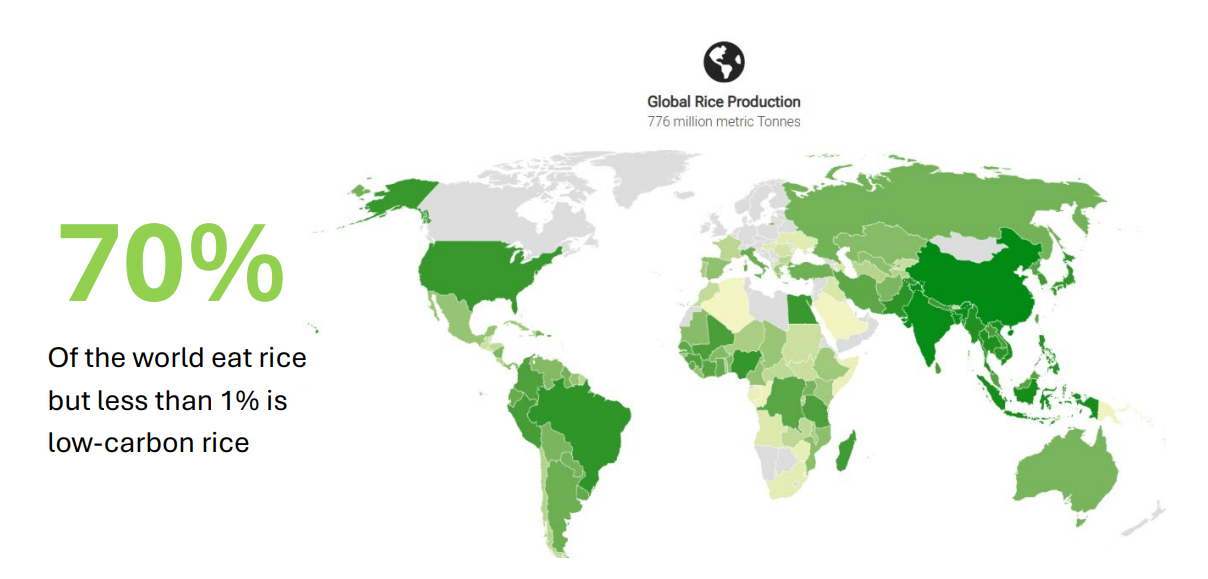
Rice is the daily staple for more than 50–70% of the global population, yet the
way it is grown today poses major environmental and economic problems. Traditional
rice farming is one of the world’s largest sources of methane and agricultural emissions.
Even worse, over 99% of rice grown globally is neither climate-friendly nor health focused and often sold at prices that leave farmers struggling to break even.
Meanwhile, demand for premium, low-carbon, and traceable rice is growing rapidly especially in the European Union, where importers are seeking sustainable products to meet new regulations like CBAM. Yet there is almost zero local supply of
climate-smart rice in these regions, creating a massive untapped market opportunity.
AEC steps in to bridge this gap with a win-win model. We empower farmers to switch from chemical-based rice to our low-carbon premium rice, using AWD+ irrigation, magnetic energy tools, and organic inputs all provided at no cost to the farmer. AEC covers the full production cost, offers technical support, and guarantees a premium buy-back price. Farmers earn more with zero financial risk. This is not just a rice project,
it is a chance to transform one of the world’s most emission-heavy crops into a global model for sustainability, food security, and rural income generation.
In 2024, the world produces over 776 million tons of rice each year but more than
99% is still grown using outdated, high-emission methods. Some countries like China, Japan, Philippines, India, and Vietnam have introduced modern techniques, but no one
Japan, Philippines, India, and Vietnam have introduced modern techniques, but no one
has built a fully integrated low-carbon rice system like AEC.
“AEC is setting a new standard for how rice can feed the world
without harming the planet.”
How AEC’s Rice Farming is Different
Rice cultivation typically takes 90 to 120 days, depending on variety, water availability, and
purpose. Some low-GI rice strains are harvested earlier to reduce sugar formation. While AWD
helps lower water use and methane emissions with minor yield benefits it mainly impacts the
mid-stage of farming.
AEC’s system starts reducing greenhouse gases from Day One, using magnetic-powered
machines, organic inputs, and optimized AWD+, delivering immediate climate and efficiency gains.
Step
Traditional Farming
Standard AWD
AEC Low Carbon System
Land Preparation
Uses diesel-powered tractors; high CO2 emissions
Similar machinery; no emission control
Magnetic-powered machines; zero CO2 emissions
Water Management
Continuous flooding → high methane (CH4) emissions
Magnetic-powered harvesters; straw reused as organic matter
GHG Emissions
Highest (CH4, CO2, N2O)
Medium; some CH4 reduction
Reduces all 3 gases; MRV-verified
Farmer Costs
Farmers bear all costs
Some cost-sharing
AEC covers all production costs
Farmer Income
Low market price; unstable income
Slightly better in niche markets
Guaranteed buy-back at premium price by AEC
Global Market Access
Rarely qualifies
Limited access
Fully aligned with CBAM/EU with traceability
Carbon Certification
None
Limited MRV in pilot zones
Verified MRV + Blockchain; credits ready for sale
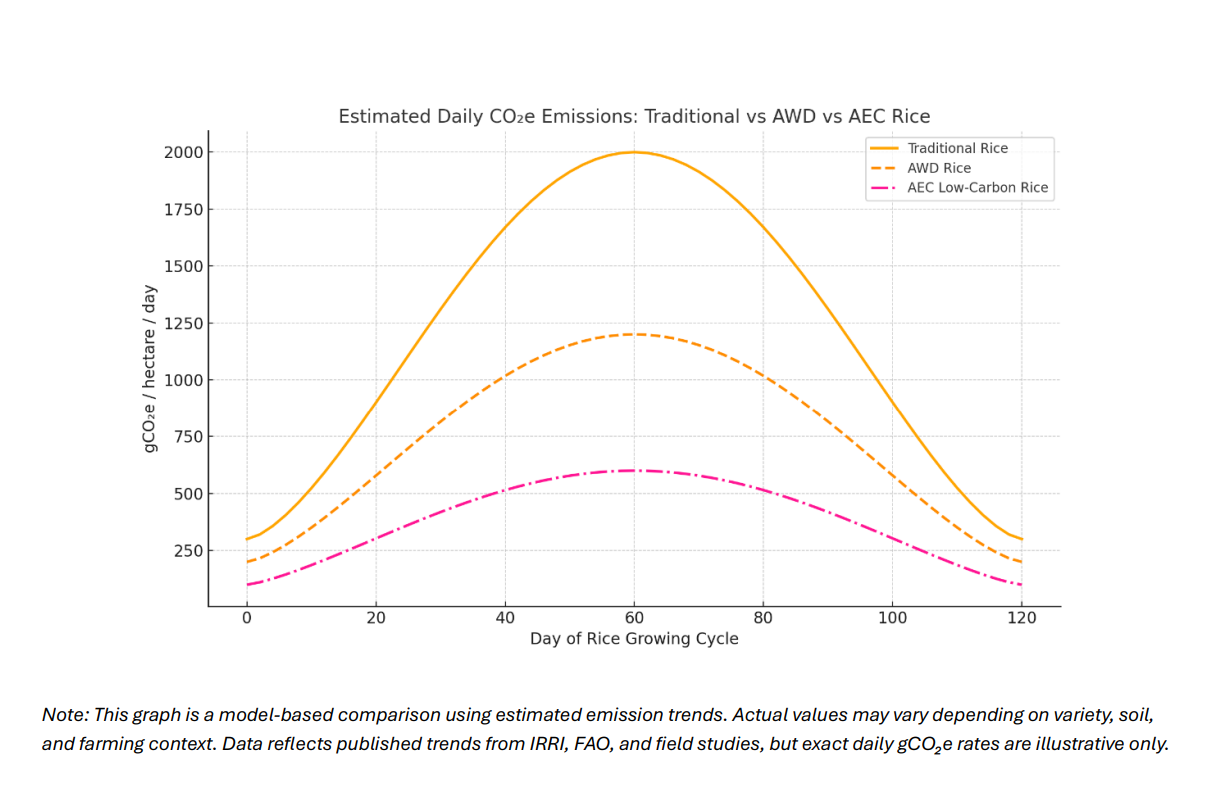
This graph compares the estimated daily greenhouse gas emissions (in gCO₂e per
hectare per day) across the full 120-day rice cultivation cycle for three systems:
Orange Line (Traditional Rice): Traditional flooded rice fields generate the highest emissions, especially during the mid-season (Day 40 - 80), due to continuous flooding and heavy chemical use. Emissions can exceed 2,000 gCO₂e/ha/day.
Dashed Orange Line (AWD Rice): Alternate Wetting and Drying (AWD) reduces
methane emissions partially, lowering overall emissions compared to traditional
methods, but still peaks mid-season.
Dotted Pink Line (AEC Low-Carbon Rice): AEC’s integrated system (AWD+,
magnetic energy, organic fertilizers) reduces emissions from the very beginning of
the cycle and maintains consistently low levels throughout even during peak
periods, staying well below 600 gCO₂e/ha/day.
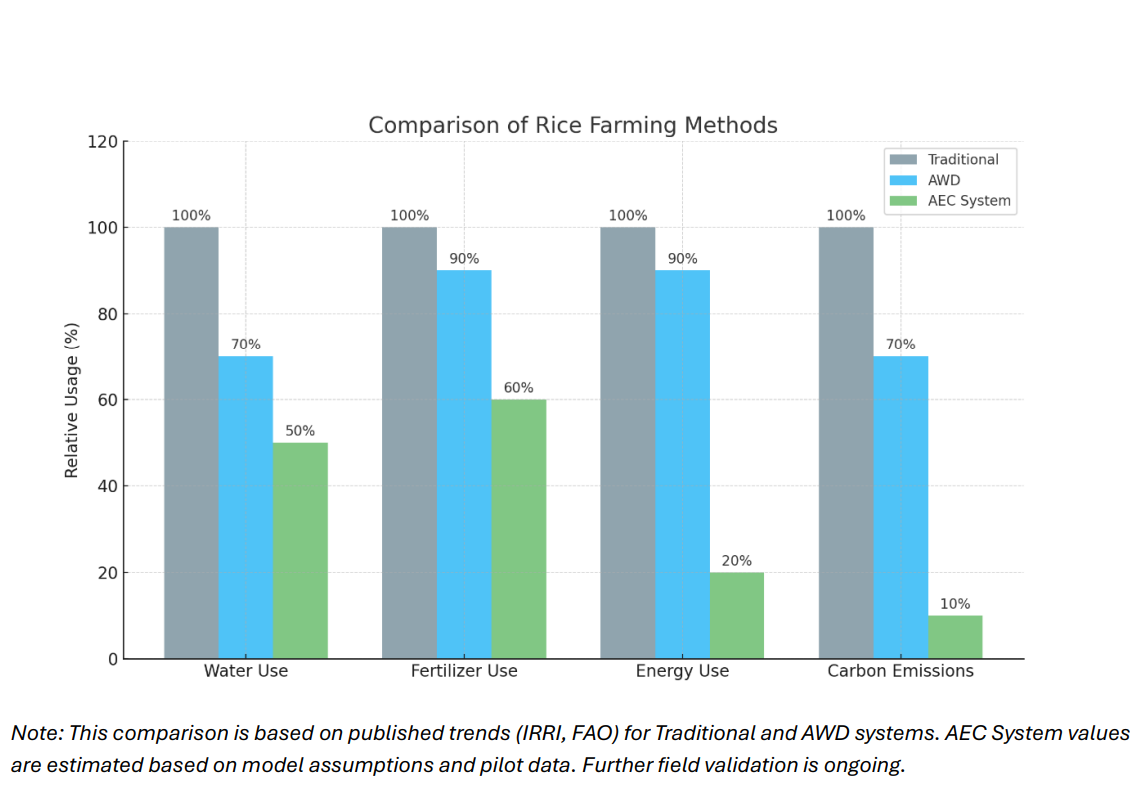
Water Use
Traditional: 100% (baseline)
AWD: 70% → ~30% water savings through alternate wetting and drying
AEC: 50% → Uses only half as much water by combining AWD+ irrigation with
magnetic-powered pumps that reduce water molecule size, improving
absorption and reducing overall usage
Fertilizer Use
Traditional: 100% (heavy chemical-based inputs)
AWD: 90% → Slight reduction due to more efficient application
AEC: 60% → Switches to 100% organic fertilizer, reducing nutrient runoff and
nitrous oxide (N₂O) emissions
Energy Use
Traditional & AWD: 100% (uses diesel or electric machinery)
AWD: Still relies on fuel-powered and electric machinery
AEC: Fully magnetic-powered machinery, producing no fuel-related emissions
Carbon Emissions
Traditional: 100% → High methane (CH₄), CO₂, and N₂O emissions
AWD: 70% → Reduces methane, but still relies on fossil energy and chemical
fertilizer
AEC: 10% → Near-total reduction in GHG emissions across all stages (land prep,
irrigation, input, harvesting)
Carbon Footprint per 1 kg of Milled Rice (by Farming Method)
Farming Method
Average Emissions (kgCO2e/kg)
Source
Traditional Flooded Rice
2.5 – 4.5
IRRI, FAO, GIZ, UNEP
AWD (Alternate Wetting & Drying)
1.0 – 1.8
IFOAM, IRRI
AEC System (Clean Energy & Organic Inputs)
< 1.0 (0.3-0.5 Goal)
Internal Estimate (AEC pilot)
AEC’s low-carbon rice emits less than 1 kgCO₂e per kg of rice making it one of the most
climate-friendly rice systems available today.
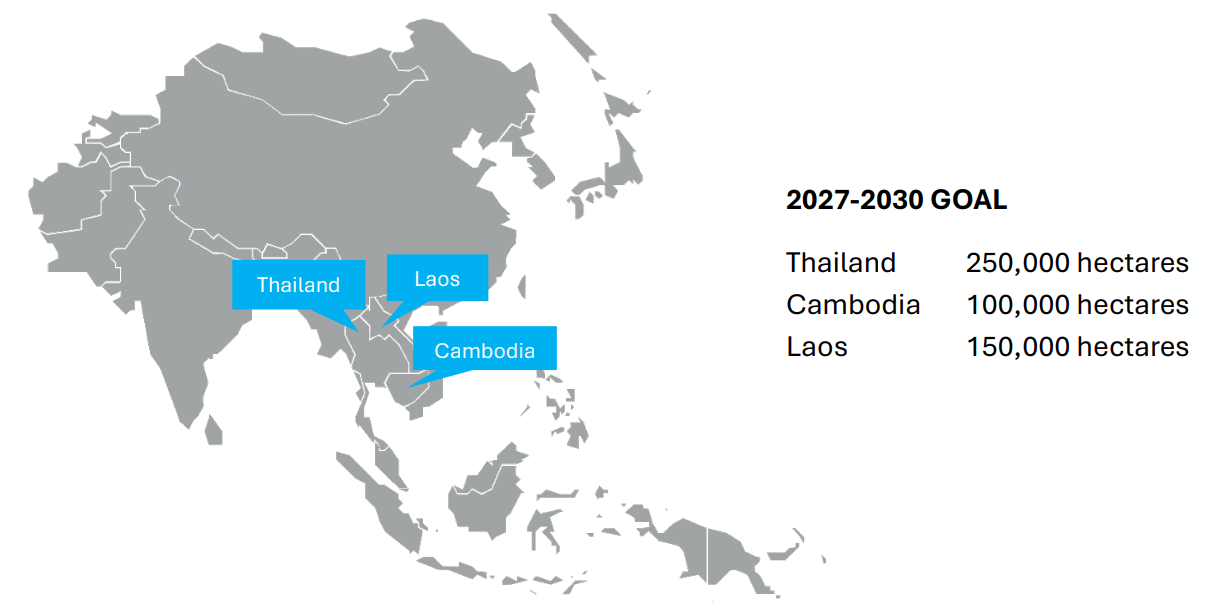
Cultivation Zones for AEC Low Carbon Rice
Expansion Plan
AEC aims to expand its Low Carbon Rice model to cover 500,000 hectares across three
primary countries: Thailand, Laos, and Cambodia. Additional expansion into other
Asian countries is currently under preparation and negotiation.
Current Readiness
As of now, a total of 15,300 hectares of farmland in Pailin and Battambang, Cambodia,
has already been registered and is fully ready for cultivation.
(Supporting documents are available in the appendix.)
Why 500,000 Hectares Matters
Reaching 500,000 hectares under the AEC model could generate over 3 million tons of
sustainable rice annually, along with more than 20 million carbon credits per year.
This would position AEC as one of the largest climate-aligned rice producers in Asia.
Scalable, Ready-to-Replicate Model
AEC’s system is modular and scalable, powered by magnetic energy, AWD+ irrigation,
and organic inputs. It requires minimal infrastructure, making it ideal for rapid
deployment across Southeast Asia, especially in countries looking to meet CBAM and
ESG-aligned export standards.
Carbon credit
The world emits over 56 billion tons of CO₂e annually, but only 0.5% of that around 300
million tons is currently offset through certified carbon credits. To meet the UN’s climate
targets, global emissions must fall by 43% by 2030 and reach net zero by 2050. This
creates massive demand for verifiable carbon reduction across all sectors.
AEC infinity aims to become a global leader in reducing carbon emissions from human
activity starting with agriculture, one of the world’s most overlooked yet impactful sectors.
What is a Carbon Credit?
A carbon credit is earned when a person, company, or project can prove that
they have reduced greenhouse gas (GHG) emissions compared to a previous
baseline. For example, if a rice farm used to release 100 tons of CO₂e per year
and now emits only 60 tons, the 40-ton reduction can potentially be converted
into 40 carbon credits.
Measured using a recognized scientific method
Reported transparently
Verified by an independent third-party organization
This process is known as MRV – Monitoring, Reporting, and Verification
The Role of Methodologies
Every type of emission reduction (e.g., CO₂, methane, nitrous oxide) requires a
specific methodology to calculate the impact correctly. These methodologies define :
Which gases are being reduced (CO₂, CH₄, N₂O, etc.)
How the data is collected (on-ground surveys, satellite, sensors)
What formulas or assumptions are used in the calculation
There is no "one-size-fits-all" different activities (like rice farming, reforestation,
renewable energy) each require a custom methodology approved by
international standards (e.g. Verra, Gold Standard, ISO).
Cost of Verification
The cost of verifying carbon credits depends on the complexity of the
methodology and the tools required. For example:
A manual, field-based methodology that requires on-site measurement can be expensive
A remote methodology that uses satellite imagery or IoT sensors may be more scalable and cost-effective
In short, the more robust and credible the methodology, the more valuable the resulting credits but also more expensive to produce.
Methane Reduction and Future Methodology Expansion
Under AEC’s current methodology, methane (CH₄) reductions from rice
cultivation can be verified at 42–60 tons of CO₂e per hectare per year through
advanced AWD+ irrigation practices. At this stage, only methane is formally verified.
However, AEC is actively developing methodologies to include:
Carbon dioxide (CO₂) from fossil fuel machinery, and
Nitrous oxide (N₂O) from fertilizer use
Once these additional methodologies are approved and implemented, AEC’s
Low Carbon Rice system will be able to verify emissions reductions across all
three major greenhouse gases in agriculture CH₄, CO₂, and N₂O through a unified
MRV system. This will not only increase the total volume of credits generated per
hectare but also position AEC at the forefront of full-spectrum, science-backed carbon credit production in the agricultural sector.
Why Carbon Credit Prices Vary So Widely
Stakeholder
Role
1. Project Developer
The producer of the credit (e.g., AEC through methane-reducing rice farming)
2. Verifier / Standard
The body certifying the credit (e.g., Verra, Gold Standard, ISO 14064, Spiro Carbon)
3. Buyer / End-User
The company or country that will use the credit (e.g., Shell, Microsoft, EU importers)
Carbon credits don’t have a fixed global price. Their value depends on how much trust
there is between three key players:
Typical Price Range (per ton CO₂e):
Type of Credit / Conditions
Estimated Price (USD)
Basic voluntary credits (VCM)
$10–25
Verified methane reduction (e.g., AWD rice)
$20–60
Credits with strong co-benefits (health, SDGs)
$30–70
CBAM-compliant CO2 credits (EU market)
$80–100
Carbon removals (e.g., DAC, biochar)
$100+
The price reflects how credible, measurable, and legally or reputationally usable the credit is in the eyes of the buyer.
Dual Pathway for AEC Carbon Credits
Carbon credits generated by AEC will be split into two primary pathways:
Offset Sales to Corporations or Government A portion of the credits will be sold directly to companies seeking to meet
internal climate goals or ESG targets by offsetting their emissions through highquality, verifiable credits.
Tokenized Credits as NFTs Another portion will be converted into NFTs on the AEC1 Token ecosystem.
These NFT-based credits will unlock various benefits within the AEC1 platform
including staking, priority access, governance rights, or future carbon-backed rewards.
Importantly, this system allows non-corporate buyers including individual investors,
climate supporters, or crypto users to own and interact with real-world carbon
credits without requiring prior involvement in the environmental sector.
“AEC aims to become a global leader in carbon credit production. Through its
scalable low-carbon rice model, AEC generates high-quality, verifiable credits that
are actively used both for corporate offsetting and within the AEC1 token ecosystem.
These credits bridge the physical and digital worlds, turning real climate action into long-term value.”
AEC1 Token: Bridging Carbon and Digital Utility
AEC1: A Token Grown From Rice, Not Hype
In the world of crypto, most tokens are built from code but AEC1 is built from soil.
Behind this token lies a real-world climate project: large-scale low-carbon rice farming in
Thailand, Cambodia, and Laos. Unlike many cryptocurrencies created for speculation,
AEC1 is backed by tangible environmental impact. Each hectare of AEC’s rice fields
reduces 40–60 tons of CO₂e per growing season, using a combination of AWD+ irrigation,
organic fertilizers, and magnetic-powered machinery. These reductions are verified
through a rigorous MRV system, audited by internationally recognized experts.
The resulting carbon credits are partly sold to offset-seeking companies and partly
tokenized into NFTs on the AEC1 platform making them accessible to everyday
participants.
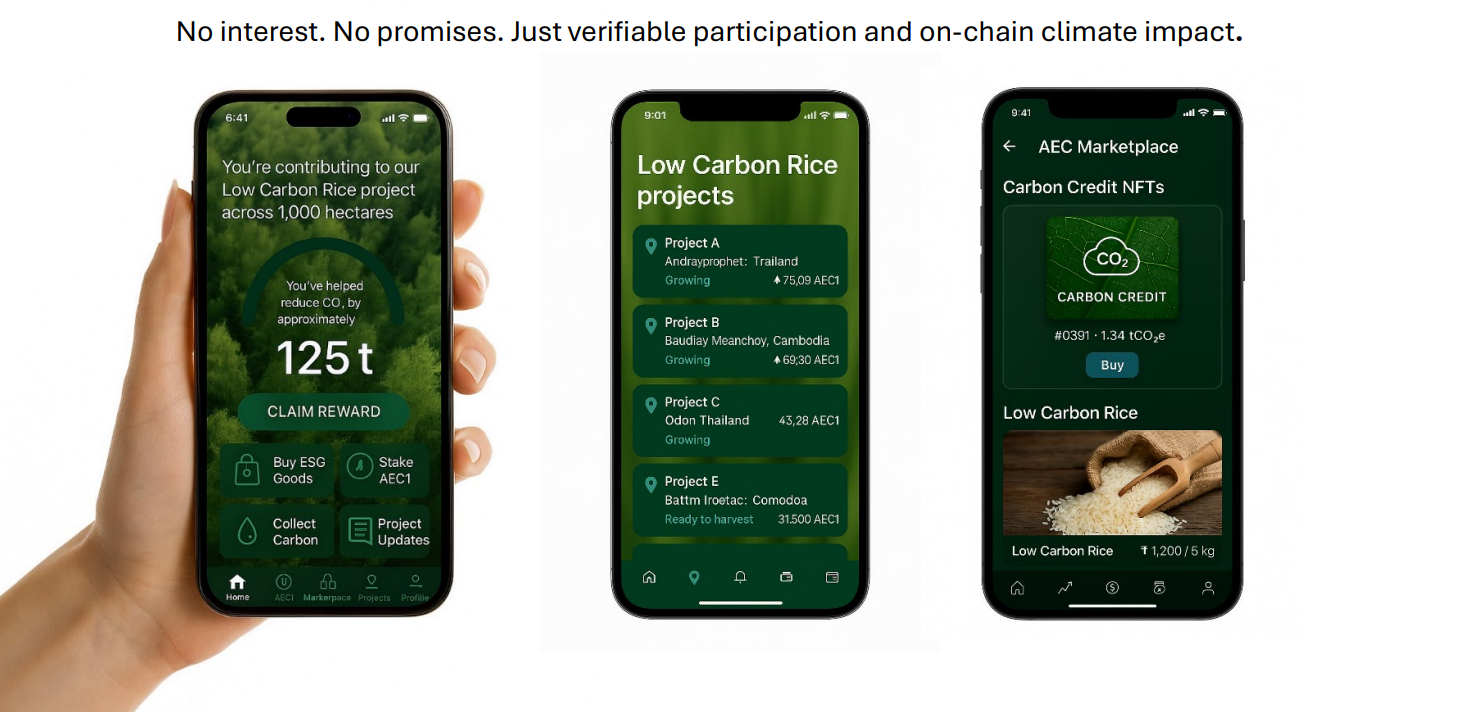
AEC1 holders can engage with the system in two powerful ways:
Carbon NFT Staking: Users can acquire CO₂ credit NFTs backed by verified rice field reductions.
These NFTs can be staked (locked) in the platform to receive AEC1 token rewards
over time.
Project-Based Staking: AEC1 can also be staked directly into real-world ESG projects.
For example, if a 10,000-rai low-carbon rice initiative in Ayutthaya opens for
participation, it may require 1.5 million AEC1 in total.
Token holders can join by staking their AEC1.
When the farming cycle ends and the project generates real revenue (from rice or
carbon sales), rewards are distributed proportionally back to stakers in AEC1.
Frequently asked questions
We believe quality pest control should be affordable and straightforward. Our plans come with upfront pricing, flexible options, and clear explanations so you always know.
We believe quality pest control should be affordable and straightforward. Our plans come with upfront pricing, flexible options, and clear explanations so you always know.
We believe quality pest control should be affordable and straightforward. Our plans come with upfront pricing, flexible options, and clear explanations so you always know.
We believe quality pest control should be affordable and straightforward. Our plans come with upfront pricing, flexible options, and clear explanations so you always know.
We believe quality pest control should be affordable and straightforward. Our plans come with upfront pricing, flexible options, and clear explanations so you always know.